Thursday, April 4, 2019

Intentional Meal Planning: Prep Work

I'm having so much fun going through this series with you all! I hope you're enjoying it as much as I am. Now that your budget is in place, so let's move on to preparation. Prep work is everything you do to get ready to meal plan. For me, that's pantry staples, a planner, and a list. You might add in something else like a menu board or coupons, so be sure to find what works best for you.


Pantry Staples

A well stocked pantry is a gift. It means you have food within reach and can start your cooking from a baseline. Once you have a pantry in place, it makes grocery shopping and cooking so much easier! But getting to that point can be expensive and tricky. When we moved last summer, I had to leave behind the majority of my pantry, and it took several months to restock.

Only you can choose your specific staples list, but here is mine:

Pantry

Over the years we have used a kitchen cabinet, a shelf in the basement, or an actual pantry closet to store these supplies. Use whatever space you have a choose your supplies accordingly!
Baking Supplies: flour, sugar, brown sugar, powdered sugar, vanilla, cocoa powder, baking powder, baking soda, cornstarch (I bake a lot!)
Herbs & Spices: salt, kosher salt, black & red pepper, garlic powder, thyme, oregano, rosemary, seasoning blends, taco seasoning packets, ranch seasoning packets
Prepackaged Foods: boxed rice mixes, mac & cheese, pasta (long noodles, shaped noodles, orzo), parmesan cheese
Canned Goods: diced tomatoes, black beans, garbanzo beans, chicken broth (mine actually comes in a box)
Sauces: tomato sauce, salsa, BBQ sauce, marinades, dijon mustard, simmer sauces, oil-based salad dressing, peanut butter
Packaged foods: tortilla chips, pretzels, baby food pouches, protein bars, popcorn
We also buy rice in a 30lb bag and store it in a giant bucket.

This is my pantry shelf where I store my non-perishables. Most of these items are from Aldi and the syrup is from Brandless.

Refrigerator

Sauces: ketchup, BBQ sauce, mustard, soy sauce, salad dressing (one creamy, one vinegar based), syrup
Dairy: milk, almond milk, eggs, sour cream, heavy cream, shredded cheese, butter
Other: jelly, lemon juice

Freezer

Veggies: chopped onions, 3 pepper & onion blend, stir fry blend, corn
Meat: chicken breast, chicken thighs, ground beef
Other: cookie dough balls, bananas, frozen fruit for smoothies, more butter

A few tips to keep your pantry up-to-date:

  • * Make a list of everything you need, but don't currently have. Add a few items to your weekly grocery list until your pantry is complete. When an item goes on sale, buy multiple packages if you have extra storage space.
  • * Use a site like Brandless to buy pantry basics at reasonable prices. We love their pure maple syrup, tahini, and baby food pouches.
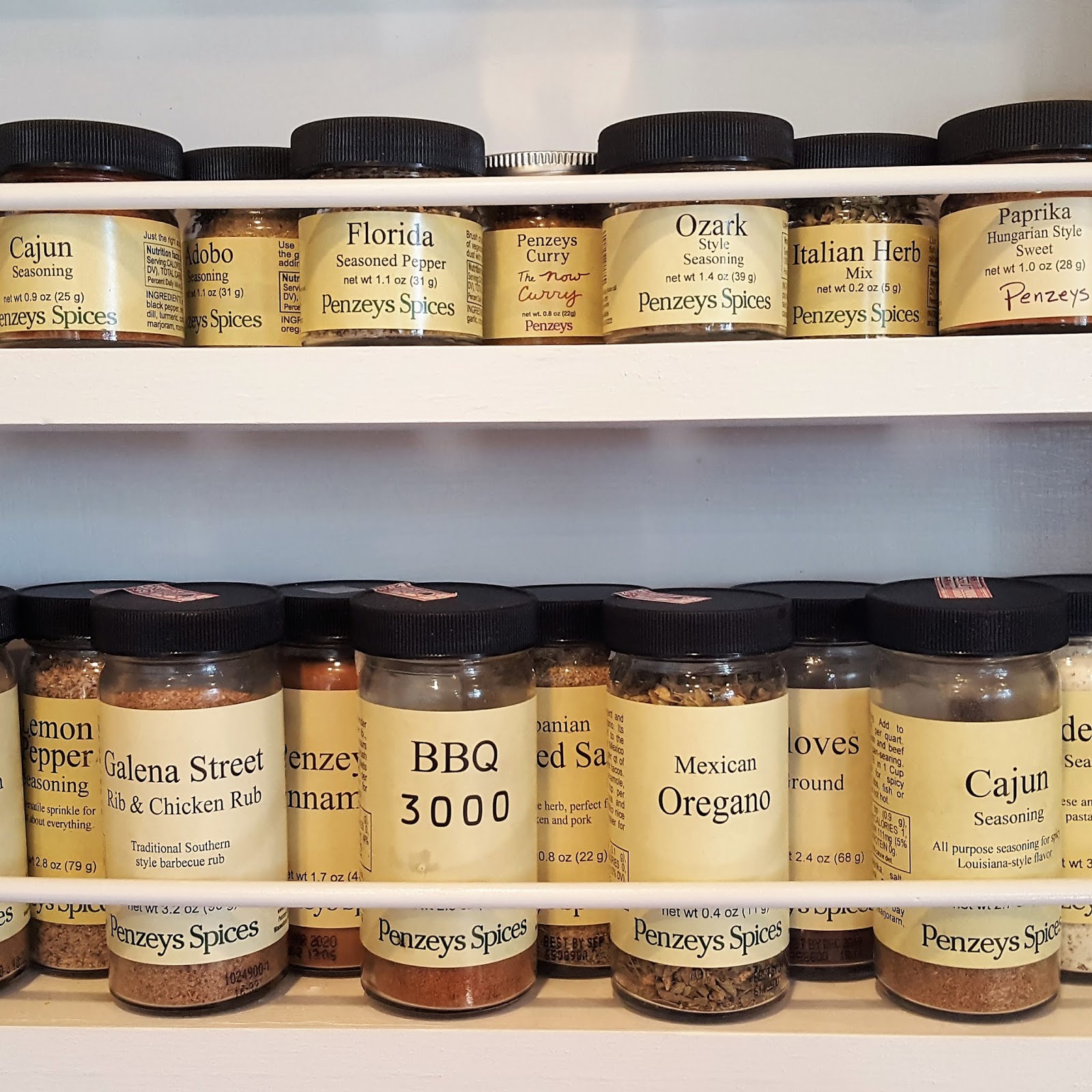
  • * Herbs and spices can be expensive, but quality makes a huge difference. I use Penzeys Spices for about 80% of my pantry. I keep a running list on my phone of spices I want or run out of, and then about once a quarter I run to our Penzey's store. I've also considered using companies like Brandless to order bulk spices, but haven't tried it yet.
  • * Decant your baking supplies into jars. I use mason jars for smaller items and plastic storage containers for the larger ones. Make sure to use clear plastic or glass so it's easy to see what supplies are running low. This also makes it significantly easier to store!
  • * As soon as you use the last of a pantry staple, grab your list and write it down for the coming week. It can be hard to remember at first, but you'll find this easier than trying to remember on grocery day or run to the store at the last minute.
Now that you have your pantry, let's move to planning meals each week. 

I typically sit down at our kitchen table on Saturday mornings with a cup of coffee and grab my planner, list, recipe books, and phone. It takes me about 30 minutes a week, and when I'm done I have a plan for the next seven days plus my completed grocery list.

Meal Planner

Meal planners come in all shapes and sizes. Some friends of mine use a menu board (this one is magnetic!) or a simple sticky note, while others have a specific planner just for meals. This year, I've been using Emily Ley's Simplified Planner that includes a box on each day to write in your dinner option. I'm planning to switch to a May Designs planner when my Simplified one ends in July and will write in our dinner selection on each day's log. May Designs also offers a specific menu planner. I'd suggest checking Target or Amazon to see what they have to offer, or ask your friends what they use.

The point here is not so much what you use as writing it down. I typically grab my calendar (on my phone or in my planner) and think through our week and what might be good to eat when. I also take into account things like the weather or visitors. I'll serve a crock pot dish if we'll be at the doctor all afternoon or a soup if it's a cold, rainy day.

As a note, I do not plan breakfasts, lunches, or snacks. I know some people do find that helpful, so find out what's best for you. I offer a small array of options for breakfast and lunch that my kids choose between. I don't eat breakfast, and Ben grabs something at work. For lunch, I eat leftovers, PBJ, or a salad with chicken. Ben takes leftovers to work on days he doesn't have a lunch meeting.

Find my planner and list pad at Simplified!

Grocery List

Here again, the idea isn't so much to have a cute list as it is to just make a list. For many years, I grabbed a $1 magnetic list pad from the Target Dollar Spot. When I ordered my planner last year, I ordered a list pad from Simplified as well. I like the idea of categories, but don't like the way it's broken up. (I usually fill a couple sections and have one or two mostly empty.) So all that to say, grab any sheet of paper pr pad you like and make a list!


Up next? Recipes! I'll share my favorite recipe books plus a few of our tried and true staple recipes that use items from my pantry.

Tuesday, April 2, 2019

Intentional Meal Planning: Budget


Now that we have our why, it’s time to prepare! Today we are going to talk budget.


My goal today is to get you ready to plan. I used to run to the grocery store, wandering the aisles and wonder how on earth we are going to get a meal plan together. I’d come home with a giant grocery bill and a whole lot of food we never ate. So this post and the next one will help you set yourself up for success.

Up today, budget and spending! I regularly hear from families that their grocery budget is too high, or that they have no idea how much they spend. Although budgets can be a pain (I hate them!) they make a world of difference. When you know how much you spend and how much you plan to spend, you can get your finances in order.

Only you and your family can set your budget, but I’m going to use mine as an example here. I recommend setting your numbers in place for the month or the year, giving you a bird’s eye view, and then dividing it into weeks. I have a goal of grocery shopping once per week, so I divide my spending accordingly.

Before I lay out our family’s plan, I also want to tell you the secret to sticking to our budget: CASH. A couple times a month I withdraw cash from the bank, divide it up, and use it for groceries and a few other categories. When my cash is gone, my spending is done. Honestly, this is super difficult for me, but it proves effective. It also forces me to get creative in how I shop if I know I only have so much cash in my wallet!

Budget


Our family spends $400/ month on groceries (around $90 per week). I plan meals weekly for our family of five (three children, ages 7, 4, and 1 plus two adults). We divide up our spending quite a bit, so this $400/month only accounts for actual food. We have a separate out-to-eat budget that allows us to go out a couple of times a month. I also have $60/month for household goods—this includes paper products, cleaning supplies, personal care items, makeup, etc, and $100/month for kids—diapers, clothes, kid activities, etc. The last category I’ll mention is what we call our “hosting budget.” We hold $40/month in an account that we use if we have families over for a big dinner or a house guest. We don’t use this every month, but we let it accumulate so we have what we need for hospitality.

So how does all this work together? I usually bring $80-100 in cash to the grocery store, plus I keep the $60 household cash in my wallet, spending as needed until it’s gone. Your budget might look different than mine, but the point is the same—make a plan and stick to it. Give yourself the goal of not overspending for a month and see how you do.


Spending


Several of the responses on Instagram were how I only spend $90 a week on groceries. Truth be told, it’s actually the most I’ve every spent! I’ve used this budget in both Colorado and North Carolina, so I have found it works in multiple areas of the country. Here are a few of the strategies I use:

Buy what’s in season.

When it comes to fresh fruits and vegetables, I could easily spend my whole budget! I have learned to buy what’s in season. I do a quick scan through the fruits and veggies, then grab whatever is on the best sale. Rather than aiming for variety each week, I aim for variety throughout the year. So we may eat a lot of asparagus for awhile, but we’ll switch to broccoli or green beans later.

This also works on some non-perishables. Baking supplies are usually cheapest between October and December. During those months, I use a portion of my weekly grocery budget on flour, sugar, and chocolate chips so I’m stocked up for the year.

Buy in “bulk.”

We don’t have a Costco membership, so bulk is a loose term. What I do is purchase products I know we’ll use in larger quantities when they go on sale. I have a general tally in my head of what good prices are on different items. If I see something at a great price, I stock up. For example, my kids love Annie’s brand organic mac & cheese. It’s usually $1.50-$2 per box. $1 per box is a great price, so when I see it at that price, I buy 10 boxes. Or if chicken happens to drop below $1.99/lb I’ll get 10 lbs. and freeze it. When Ben and I first got married, we had pasta night at least once a week—we used to wait for our favorite pasta sauce and noodles to go on sale and then buy 20 jars and 20 boxes of noodles. We eat a little less pasta now, but the idea is the same!

Use your freezer!

Like I mentioned with chicken above, when I find a good price on meat, I buy it and freeze it. I like using quart size freezer bags so it’s pre-portioned and easier to defrost.
I like to buy frozen veggies in the freezer aisle. Did you know that for around $1 you can get a back of frozen, chopped onion that’s about the same as 3 onions? I love these because they don’t go bad and they’re so much easier to cook with! I also buy veggie stir fry blends, peppers & onions, and frozen corn.
I also like to freeze cookie dough balls. When I bake, I’ll double the batch and freeze half in balls. Next time I need cookies, I don’t have to do a last minute store run for chocolate chips or flour.

Shop around.

After years of shopping, I know what costs less where. Particularly since we’ve moved to North Carolina, I buy certain things at certain stores. I typically do my weekly grocery shopping by stopping at Aldi first, then finishing at Harris Teeter. I also have a short list of items that are cheapest at Wal-Mart. Sometimes I’ll set aside a little money and grab those items the next time I’m shopping there. In Colorado, I used to buy most things at King Soopers (a Kroger store) and follow up at Sprouts Farmers Market.

Buy less organic.

I know, I know, organic is all the rage right now. Personally? I’m not always convinced that organic is the best way to go. Sometimes it feels more like a brand tax than an actual difference. I tend to look for more “natural” products or a small ingredients lists than organic. And while I do look for “no growth hormones” in my milk, eggs, and meat, I don’t buy free range or organic unless the price is right. For produce, I try to buy organic if it’s on the dirty dozen list, but otherwise I stick to regular.

Skip the name brands.

Unless you have a very favorite product (for us it’s Blue Bell Ice Cream), skip the name brand and go generic. You can usually find a product that’s basically the same thing for much less money.

Choose a “meat of the week” and use it multiple times

This week I bought 3 ½ lbs of chicken. Yesterday we had grilled chicken, tonight we’re eating chicken tacos, and later this week I’ll make chicken curry. Last week I used ground beef for tacos and hamburgers. Another week Ben smoked a pork butt that we used as pulled pork, taquitos, and pork sandwiches. I aim for around 3 days with the “meat of the week” and then fill in with vegetarian options or out-to-eat days in between.

Have a few weekly meal staples.

We always eat some form of tacos on Tuesday and make homemade pizza on Friday or Saturday night. I know this, so I am always planning ahead for the ingredients. When cheese goes on sale I buy a lot and freeze it. I do the same with tomato sauce.

Keep your options simple.

With three kids, the name of the game is easy. We give our kids a few good options for breakfast (oatmeal, toast, or cereal) and lunch (PBJ, grilled cheese, turkey sandwich, mac & cheese), and our family all eats the same dinner. I also buy a few snacks (off brand!) in large boxes for the kids to enjoy.  I don't buy juice, soda, pre-made lunch kits, or individually pre-packaged snacks. Honestly, they're bad for kids anyways and they are expensive. I have a couple reuseable snack bags I send to school with Eli or take to the park instead.
\\


Take the next week and set your budget with your partner. Find a number you can both agree on, then give it a go for at least a month before you make changes. And let me know how it goes! I can't wait to hear!

Monday, April 1, 2019

Intentional Meal Planning: the Vision


Do you meal plan? I didn't for a long time. It sounded too difficult, time consuming, and honestly a little boring.  My plan was this notebook above, completely blank.

Since our move to North Carolina last August, I've found meal planning to be really helpful. One of our family goals with our move was to eat dinner together as a family around our table, something we hadn't been doing very often before. If we were going to eat at home, that meant I was responsible for getting dinner on the table! After a few nights of staring at my fridge wondering what on earth to cook, I realized meal planning was the way to go. With a great deal of trial and error, I have found a system that generally works for our family.

I did a quick Instagram poll over the weekend, wondering if you all would be interested in this, and I got so many questions! In fact, what began as one post has now turned in to a whole series on intentional meal planning. I'm so excited to write about this and I hope sharing with you all will be helpful. I want to hear your questions: comment and tell me what you’d like to know about meal planning!

Casting a Vision


Before we jump into how I meal plan, I want to give you the why. It can be easy to run through our weeks, months, and years without really considering why we do what we do. One day we are parenting toddlers, and the next our children go off to college (or so I’m told! I’m still waiting for that one!). As my Grammy and Mom remind me, the days are long but the years are short. I know I don’t want to miss what is most important with my children, and I imagine you don’t either. Think about meal planning within the greater ideal of family mealtime. We all hope for meals around the table with the ones we love, and meal planning is one vehicle that drives us to that goal.

I sometimes hear anecdotal claims about the value of family mealtime, but does it actually carry significance?  It does in fact, carry a lot of significance, beginning with God's view on family mealtime. 

In Deuteronomy, Moses speaks the greatest commandment to love God to the whole tribe of Israel, and then follows it with this: “And these words that I command you today shall be on your heart. You shall teach them diligently to your children, and shall talk of them when you sit in your house, and when you walk by the way, and when you lie down, and when you rise.” (Deuteronomy 6: 6-7). Moses very specifically instructs parents to pass down these ideals to their children, including when you “sit in your house.” In our home, we are most likely to be sitting around the dinner table (or the television-being honest here!). What does this mean for you and I? It means that God wants us to gather our children around the table and teach them about Him. Our primary objective as parents is to point our children to Jesus, and one of the best ways to do this is around our dinner table. When I meal plan, I am calmer at dinner and more ready to talk to my children, instead of feeling frazzled and rushed, throwing fast food into the backseat while we drive to soccer. As we work through this series on meal planning, always keep this ideal in mind. You aren’t meal planning to be super mom or to look good to others or even to save money. You are meal planning to point your children to Jesus.

Let’s jump forward a little now and look at scientific reasons for family mealtime. This issue has been frequently studied, and the research is quite illuminating. The familydinnerproject.org states “Over the past 15 years researchers have confirmed what parents have known for a long time: sharing a family meal is good for the spirit, the brain and the health of all family members.” Goodnet.org lists nine scientifically proven reasons to eat dinner as a family, including better family relationships, healthier food choices, and stress relief. PsychologyToday takes it a step further citing “a study done by The National Center on Addiction and Substance Abuse revealed that teens who eat fewer than three family dinners per week compared to those who eat five to seven a week are twice as likely to use alcohol and tobacco and one and a half times more likely to use marijuana.” I don’t know about you, but I hope my children will grow to be happy, healthy, drug-free teenagers. If meal times together around the table can lower their risk, I am willing to do a little meal planning to make it happen.

Personally, for our family meal planning has given us time together, a less stressful week, and money saved. We rarely go out to eat and instead are really enjoying our nights at home together. Had you told me this six months ago, I would have been so surprised! Friends, this can be done and I’m excited to share my tips with you!

Before you go any further, think about your own why. Often the greater reason behind a task will change it from a chore to a privilege.


Up next: Part 2- Set Yourself Up for Success. I’ll walk you through our budget, pantry, and meal planning essentials.

Wednesday, March 27, 2019

Storing and Displaying Children's Books

My house is overrun with books. I don't just mean one here or there, but truly, they are spilling over in our bedrooms, living room, playroom, and even in the car. When I clean our house, half the battle is putting books away.

This is entirely my fault. When I make my own birthday list or ask for gifts for our kids, my requests are primarily books. Every grandparent sends at least one book per child at every birthday and Christmas. My mom started a monthly "Nana's Book Club" at my suggestion. I spend all my extra dollars on books for myself.


It should come as no surprise that books dominate our home's shelves and floors and tables and closets.  I've tried many different ways of storing them through the years, but always struggled to find enough room for our growing collection. I weed out books occasionally, but how do you give away a book?! Even Marie Kondo has to admit that books spark joy.

Our new-to-us home here in North Carolina finally seems to have met my challenge for a book-friendly house. We have built-ins in our bedroom, living room, and office, plus I've added more shelves in our formal living-room-turned-library.

Today I have a few tips for you on storing and displaying your books. It can be a challenge to know where to put all those beloved books, so I hope this helps!

Keep Like Books With Like

Tell me I'm not the only one who has promised a book to a friend, only to search my whole house and come up empty. I store books all over my home, and with so many places to look it can be difficult to find a specific book. With our move last summer, I decided to generally store similar types of books together. For me, this means adult books on our bedroom shelves, books about our careers (in our case engineering and counseling) in the office, and children's books in the library/playroom. I also try to use each shelf for a theme, like parenting, or fiction, or elementary chapter books, so that my kids or I can look in one spot for similar types of books. I don't stick to this rule religiously, but I have found it makes finding books easier!

Print is a card from Gracelaced, succulent is from Target, bowl is old from Crate & Barrel

Decorate With Books

Books are my favorite accessory for my home. They are beautiful, colorful, and useful- the perfect way to fill shelf space. To begin, I usually grab a stack of books that match my color scheme or are just really pretty. Sometimes I'll grab books by a similar theme, but often I simply choose books I love. I find candles, fake plants, and framed art go well with books if you are looking to style a shelf in your home.


Make Reading Easy

My children and I read more when we can grab a book easily and quickly. For this reason, I usually keep a stack of books on our coffee table and end tables. I'll often scatter library books around the house for anyone to pick up and read.

I also have a dedicated space in my children's rooms for a few books. This doesn't have to be fancy, just a spot where they can enjoy a book when they're in the bedrooms. For Theia (15 months), I have a couple Indestructibles books I keep near her crib and I hand her one at nap time. I especially love these because she can't ruin them. Trust me, board books get SO MUCH LOVE in a crib! For Tessa (4) I cleared a shelf in her closet's built-ins for a few books. She often wanders up to her room with books, so to clean up at bedtime I have her fill the shelf, then return any extras back to the playroom. For Eli (7), I have a stack on his nightstand and a "bookshelf" balanced between his bedpost and spare mattress at the foot of his bed. Remember, form over function! The goal is for our kids to be reading, not for it to look perfect.


Store Books Within Reach

While I do love keeping books all around my house, I find having most of our children's books in one specific spot is the best option for true book storage. We converted our front room into a library, so it has a couch, two bookshelves, Eli's homework desk, a reading chair, and the Lego table (it opens right into the playroom). These bookshelves are the primary home for all our children's books.

When I store the books, I do it so that each child has access to age-appropriate books. This means board books on the bottom shelves, picture books next, then chapter books on the higher shelves. I want my kids to walk or crawl right up to the books that are at their current reading level.


Display Books for Your Children

I've hear from many different sources recently that kids respond better to books with covers facing out than to a stocked shelf with the spines facing out. I've tried this myself and found it to be true. With my move to consolidate books to certain locations in our home, the bookshelf in the playroom was freed up for my to try this idea. I've begun displaying a few selected books face-out for my kids to explore. I change out the books every few days, giving them a chance to finally read our library of children's books. It's also a fun way to focus on a particular theme, season, or holiday by choosing specific books. Plus, this gives me a chance to read-aloud something other than Curious George every. single. day.


How do you display your books? Do you have any tips or tricks?


Tuesday, March 19, 2019

Hidden Days of Motherhood

Has anyone else been sick for days and days? We haven't been able to kick this round of sickness for a couple of weeks now. All five of us have gone down, and I'm the final casualty. Today I can barely talk, which doesn't work well when I have to keep little people alive. 

I find that sickness pulls me back toward home, into a reflective mood and quiet days. The busyness of life gives way to unexpected days at home and cancelled plans. This has felt really lonely. It has also been much-needed. 


I was talking with my sister and a close friend last week about how difficult motherhood can be. I often feel unseen and unimportant. I feel constantly frustrated with the complaints and needs of my children. I know in my head that being home with my children matters, but in the everyday diaper changes, nose wipes, and time-outs, it often doesn't feel that way. In both conversations, my sister and friend reminded me that seasons of quiet, unnoticed work matter to God. My sister pointed me toward God's name "El Roi" which means the God who sees me. (I've been diving deep into this name of God and have so much more to say about it soon.)

In the hidden days of motherhood, isn't it a gift that God sees us? Our long days don't go unnoticed to him. He celebrates or victories and draws us near when there are tears. I hope today you can grab hold of the comforting presence of God in your smallest, dirtiest, loudest moments.